Best Espresso Grinders Under $200
By PullRatio . 8 min read . Updated August 2026
Two hundred dollars is a real, honest budget for a first espresso grinder, and it is enough to buy something genuinely capable of espresso-fine, consistent grinds. It is not enough to buy a stepless flat burr grinder or near-zero retention, so this guide is deliberately narrow: it covers the grinders that actually earn a recommendation under $200, rather than padding the list with options that only look good on paper. The short version is that Baratza Encore ESP is the best electric pick and Timemore C3 Pro Hand Grinder is the best hand grinder pick, and which one is right for you comes down to how many shots you pull each morning.
Quick answer
Under $200, the Baratza Encore ESP ($170 to $195) is the best electric espresso grinder: stepped espresso-range settings, Baratza's repair support, and a real upgrade over any built-in machine grinder. If your budget is tighter or you only pull one or two shots a day, the Timemore C3 Pro hand grinder ($75 to $90) delivers espresso-fine, consistent grinds for less.
This guide contains affiliate links. PullRatio may earn a commission at no cost to you.
What $200 actually buys in a grinder
At this budget you are choosing between two real categories of grinder: an electric grinder with stepped burr adjustment, or a hand grinder with a stable shaft and quality steel burrs. Both can produce a genuinely consistent espresso-fine grind. What you give up compared to a $500-plus grinder is stepless micro-adjustment, near-zero retention, and the speed of a large motor, not the ability to make good espresso.
Retention matters more at this price than most buyers expect. A grinder that holds onto several grams of coffee between doses wastes beans and mixes yesterday's stale grounds into today's shot. Both grinders in this guide manage retention reasonably well for their price, which is part of why they make the list and other similarly priced options do not.
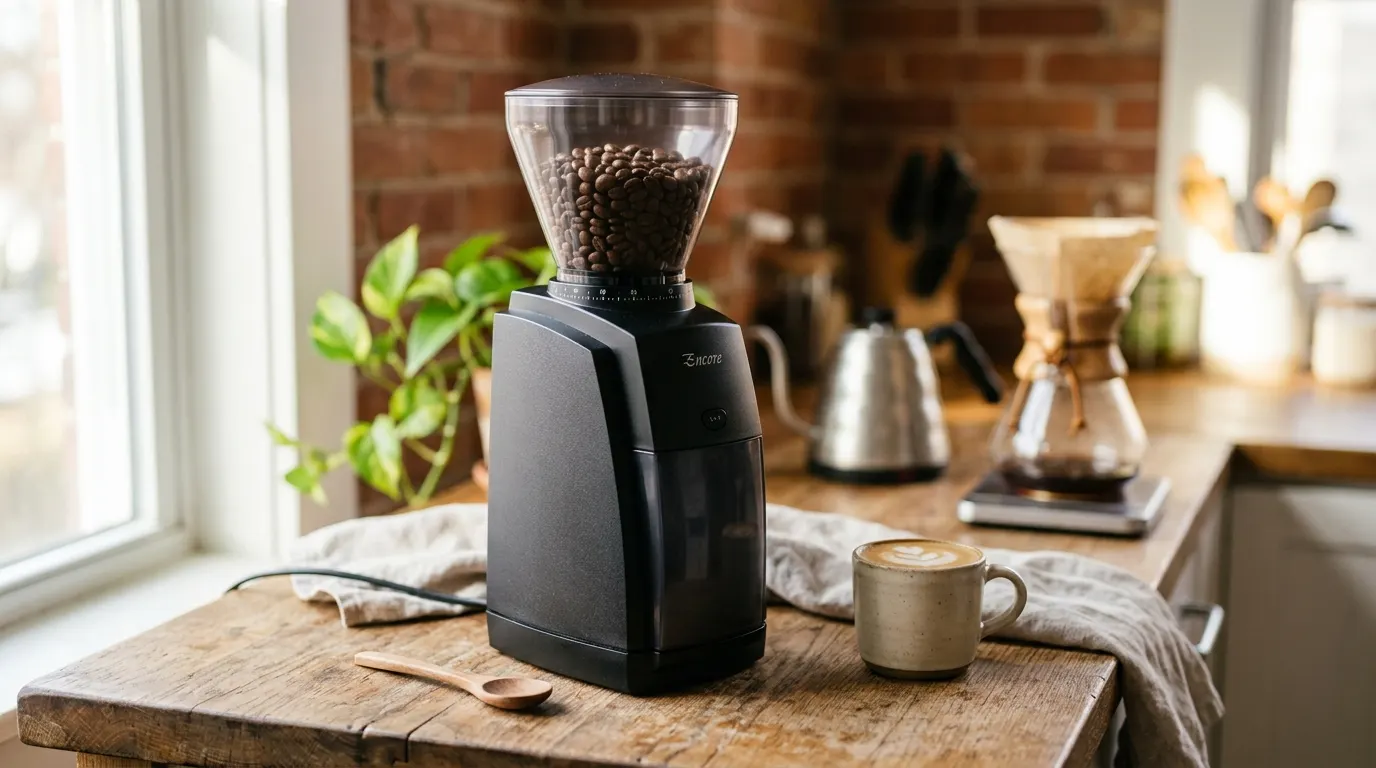
Best electric pick: Baratza Encore ESP ($170 to $195)
The Baratza Encore ESP uses 40 mm conical burrs and a high-resolution espresso grind range. Its included dosing cup fits 54 mm portafilters and comes with a 58 mm adapter, so it suits entry-level machines such as the Breville Bambino Plus .
The single-dose mode keeps mess and leftover grounds to a minimum, though conical burrs do retain a bit more between doses than a flat burr design. For most buyers upgrading off a built-in machine grinder or pre-ground coffee, that trade is easy to accept given everything else the Encore ESP gets right.
This is the pick if you pull two or more shots most mornings and want the grinding itself to be fast and hands-off.
Best hand grinder: Timemore C3 Pro ($75 to $90)
The Timemore C3 Pro Hand Grinder uses an S2C stainless steel burr set that produces genuinely espresso-fine, consistent grinds, which is not true of most hand grinders at this price. A stable central shaft limits the wobble that ruins grind consistency on cheaper hand grinders, and clear, repeatable grind settings make dialing in straightforward.
The honest trade-off is time and effort: grinding an 18 gram double shot by hand takes 60 to 90 seconds of steady cranking. For one or two shots a day, that is a manageable ritual and the C3 Pro is genuinely capable enough to reveal what your machine can do. For a household pulling four shots on a weekend morning, that effort adds up fast.
It is also the better choice if counter space or portability matters, since it packs small enough for travel or a tight apartment kitchen where an electric grinder does not fit.
If you can stretch: DF64 Gen 2 ($220 to $280)
The DF64 Gen 2 Single Dose Grinder is not under $200, so it is not one of the two picks above, but it is close enough that it deserves a mention if your budget has a little flexibility. It moves you into 64 mm flat burrs with stepless adjustment and an upgradeable burr carrier, a meaningfully different tier of grinder than either pick in this guide.
If $200 is a hard ceiling, skip this one and buy the Encore ESP or the C3 Pro instead. If you can find an extra $20 to $80, the DF64 Gen 2 is worth comparing before you commit.
Getting the most out of a budget grinder
A $170 grinder paired with good puck prep can outperform a $170 grinder used carelessly by a wide margin. Break up clumps with a Normcore WDT Tool before tamping, since channeling is the most common way a budget grinder's output gets ruined between the basket and the cup.
A calibrated tamper like the Normcore Calibrated Tamper V4 removes tamp pressure as a variable too, which is worth doing before you start second-guessing the grinder itself. Most complaints about a budget grinder's shot quality actually trace back to inconsistent puck prep rather than the burrs.
Weigh your dose and yield with a simple scale rather than pulling by time alone. You do not need an expensive model for this: a basic 0.1 gram scale is enough to hold a consistent brew ratio and isolate what changed when you adjust the grinder.
Featured in this guide
Keep reading
Related comparisons
Related roundups
FAQ
Frequently asked questions
Can a grinder under $200 actually make good espresso?+
Yes. Both the Baratza Encore ESP and the Timemore C3 Pro produce a genuinely consistent, espresso-fine grind, which is the main thing a grinder needs to do well. What you give up under $200 is stepless micro-adjustment and near-zero retention, not the ability to pull a good shot.
Should I buy an electric or hand grinder under $200?+
Buy electric if you pull two or more shots most mornings and want grinding to be fast and hands-off; the Baratza Encore ESP is the pick. Buy a hand grinder if you pull one or two shots a day, want to save $80 to $100, or need something compact for travel or a small kitchen; the Timemore C3 Pro is the pick.
Is it worth spending $220 to $280 on the DF64 Gen 2 instead of staying under $200?+
Only if your budget has real flexibility. The DF64 Gen 2 moves you to flat burrs and stepless adjustment, a meaningfully different tier. If $200 is a hard ceiling, the Baratza Encore ESP or Timemore C3 Pro is the better call rather than stretching past your budget.
Will a built-in machine grinder work instead of buying a standalone one under $200?+
Most built-in grinders on entry-level machines produce a less consistent grind than a dedicated standalone grinder at this price. If you already own a machine with a built-in grinder, a standalone upgrade like the Baratza Encore ESP is usually the single biggest improvement you can make to shot quality.
What else should I budget for alongside a sub-$200 grinder?+
A WDT tool and a calibrated tamper together cost well under $100 combined and remove two of the most common causes of inconsistent shots: channeling and uneven tamp pressure. A basic scale for weighing dose and yield is the other low-cost addition worth making before you spend more on the grinder itself.