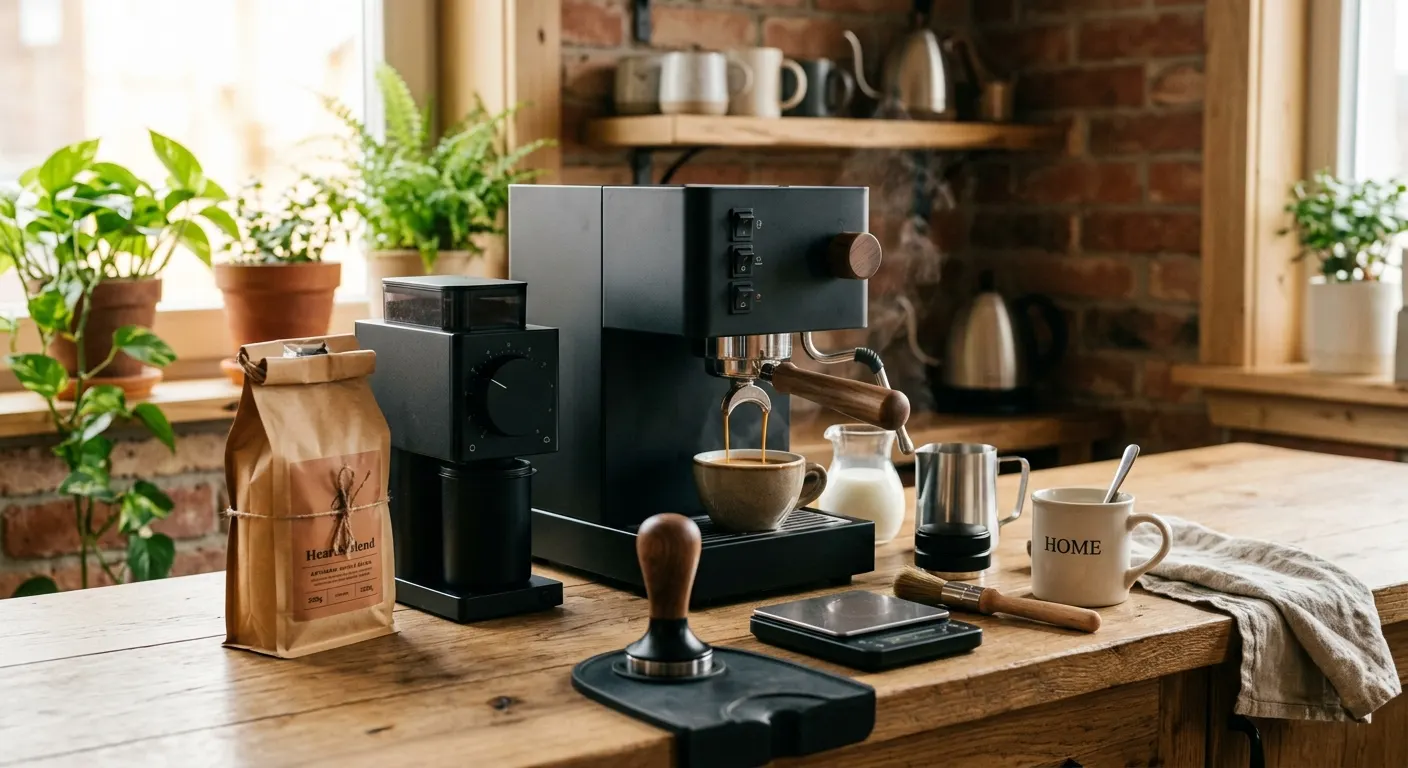
The Complete Espresso Starter Kit Under $500
By PullRatio . 10 min read . Updated September 2026
A complete home espresso setup that actually works does not require $1,500, but the Breville Bambino Plus now runs $400 to $500, which no longer leaves room for a real grinder under a $500 ceiling. This build swaps in the De'Longhi Dedica Arte and a hand grinder instead, and totals $383 to $480 across current bands even if every part lands at the top of its price range at once. The trade-off is real: the Dedica ships with pressurized baskets, which cap the extraction ceiling regardless of grind quality, and the grinder is manual. This guide explains the build, the honest trade-offs, and the step-up path once the budget allows an electric grinder and a swappable basket.
Quick answer
A truly-under-$500 build pairs the De'Longhi Dedica Arte ($250 to $300) with the Timemore C3 Pro Hand Grinder hand grinder ($75 to $90), a scale, a WDT tool, and a cleaning brush, totaling $383 to $480 across current bands. Step up to the Breville Bambino Plus plus Baratza Encore ESP ($590 to $700 combined) once the budget stretches to an electric grinder and a machine that takes a single-wall basket.
This guide contains affiliate links. PullRatio may earn a commission at no cost to you.
Budget reality: where to spend and where to save
The fundamental rule in espresso is grinder first, then machine, because the grinder controls particle size and that sets how evenly the shot extracts. This specific build is the exception that proves the rule: the Dedica Arte ships with pressurized baskets, which cap the extraction ceiling regardless of grind quality, so a better grinder buys less headroom here than it would on a machine with a single-wall basket. Grinder-first spending still matters for consistency, but do not expect this pairing to hit the same ceiling as the step-up path below.
A reasonable split for this build: $250 to $300 on the Dedica Arte, $75 to $90 on the Timemore C3 Pro hand grinder, and the remaining $58 to $90 on a scale, a WDT tool, and a cleaning brush. You end up with hardware that is capable and honest about where it stands, with a clear upgrade path when the budget grows.
Machine: De'Longhi Dedica Arte ($250 to $300)
At $250 to $300, the De'Longhi Dedica Arte is the machine that keeps this build under $500 at all. Its 15 cm wide body fits the tightest counters, it warms up in about 40 seconds on a thermoblock, and it works with both ground coffee and ESE pods.
The honest trade-off: the pressurized baskets cap the extraction ceiling no matter how good the grinder feeding it is. This is the right machine when budget or counter space is the binding constraint, not when you want the most headroom to grow.
Grinder: Timemore C3 Pro Hand Grinder ($75 to $90)
The Timemore C3 Pro Hand Grinder uses an S2C stainless steel burr set that produces genuinely espresso-fine, consistent grinds, which is what keeps this build honest despite the pressurized basket above. A stable central shaft limits the wobble that ruins grind consistency on cheaper hand grinders.
The trade-off is effort and time: grinding an 18 g double shot by hand takes 60 to 90 seconds of cranking. For one or two shots a day that is a manageable ritual, and it is the only way this build stays under $500 with a genuinely capable grinder rather than a built-in or blade grinder.
Scale: Timemore Basic Plus Coffee Scale ($35 to $50)
A scale is not optional for dialing in espresso. Pulling shots by time alone without knowing the yield produces inconsistent results even when everything else is right. The Timemore Basic Plus Coffee Scale is a dual-mode, USB-rechargeable scale with 0.1 g resolution and a built-in timer, at a price that leaves the rest of the budget for the WDT tool and cleaning brush.
Its response is slower than a dedicated espresso scale, so it suits weighing the dose in more than tracking a live pour. Weigh 18 g in, pull the shot, then weigh the cup after: a 36 g yield in 25 to 30 seconds is a standard starting point. Adjust grind coarseness until that ratio produces a shot that tastes balanced rather than sour or bitter.
Puck prep: a WDT tool
Channeling from uneven distribution is the most common shot problem for beginners and the most impactful single fix available at this budget. The IKAPE WDT Tool at $15 to $25 is the entry point that keeps this build under $500; step up to the Normcore WDT Tool at $25 to $35 later once you know the technique is working for you.
A calibrated tamper is a genuine upgrade, but measure your own basket before ordering one, since sizing it wrong wastes the purchase. The Bambino Plus step-up path below uses a confirmed 53.3 mm tamper, so sizing is a non-issue there.
Cleaning: what you need from day one
The Espresso Group Head Cleaning Brush is the cheapest real cleaning tool in the catalog and works on any machine: two-sided nylon bristles for scrubbing the shower screen, dispersion plate, and group head gasket after each session.
The next add, not required to keep this build under $500 but worth budgeting for soon after: the Puly Caff Espresso Machine Descaler is a liquid espresso descaler, and the Dedica runs a thermoblock, so check the descaler label and the machine manual for compatible descalers before using it. Cafiza-style backflush tablets are worth adding too if your machine takes them, once you have confirmed what your specific unit supports.
Step up from this kit: Bambino Plus and Encore ESP ($590 to $700)
Once the budget stretches past $500, the Breville Bambino Plus ($400 to $500) plus the Baratza Encore ESP ($190 to $200) is the natural next build, totaling $590 to $700 combined. You get an electric grinder instead of hand-cranking, and a machine that takes a swappable single-wall basket instead of the Dedica's stock pressurized baskets, so the grinder-first rule applies at full strength again.
From there, the standard roadmap holds: add a Normcore Calibrated Tamper V4 in 53.3 mm for the Bambino Plus, then when you are ready to upgrade the grinder further, the next step up from the Encore ESP is the DF64 Gen 2 Single Dose Grinder for flat-burr performance, or the Niche Zero for the workflow most Classic Pro owners eventually reach.
Featured in this guide
Keep reading
Related comparisons
Related roundups
FAQ
Frequently asked questions
How should I split a 500 dollar espresso budget?+
For a truly under-$500 build: roughly 250 to 300 dollars on the Dedica Arte, 75 to 90 on the Timemore C3 Pro hand grinder, and the remaining 58 to 90 on a scale, a WDT tool, and a cleaning brush. That totals 383 to 480 dollars even at the top of every band. The goal is capable, honest hardware with a clear upgrade path once the budget grows past 500.
Can I really make good espresso for under 500 dollars?+
Yes, with two honest caveats. The Dedica Arte ships with pressurized baskets, which cap the extraction ceiling regardless of grind quality, and the Timemore C3 Pro is a hand grinder that takes 60 to 90 seconds of cranking per double shot. Within those limits it produces genuinely espresso-fine, consistent grinds, and technique and fresh beans matter more than spend at this level.
If money is tight, what do I buy first and what can wait?+
Buy the machine, grinder, scale, and a WDT tool first, since channeling and inconsistent grind are the most common beginner problems. The group-head brush is cheap enough to buy with the machine. A calibrated tamper, a precision basket, and a descaler can wait: measure your basket before ordering a tamper, or step up to the Bambino Plus path, which uses a confirmed 53.3 mm size.